Six steps from a cold start to a self-serve team.
Onboarding runs in a fixed order. Each step has an owner — and on all but a few, the owner is us. Here is exactly what happens, in sequence, and what we'll need from you at each one.
Connect your sources.
Every source connects through a guided self-serve flow — no engineering, no pipeline configuration, no data to move. OAuth, an API token, or credentials, depending on the source. Most connections complete in under five minutes, and every connector is built and maintained by Supper's own team.
Supper builds your semantic model.
The moment a source is connected, Supper's AI scans your entire schema, maps every table and field, infers join paths across sources, translates internal field names into plain language, and generates a first-pass semantic model — automatically. By the time you check in the next morning, the foundation is already built.
This is the difference from tools that need weeks of modeling before your first question. The AI does the heavy lifting upfront, so you can start immediately.
Your FDA refines the model with your team.
Your Forward Deployed Analyst — a full-time Supper employee with a senior data background — reviews the generated model with your team, encoding your specific business logic and resolving anything that doesn't match how your company actually works. Your team reviews and approves in short async sessions.
- Metric definitions encoded to spec — ARR, churn, pipeline
- Conflicting definitions resolved across sources
- Cross-source relationships validated end to end
- Permissions and field-level access applied
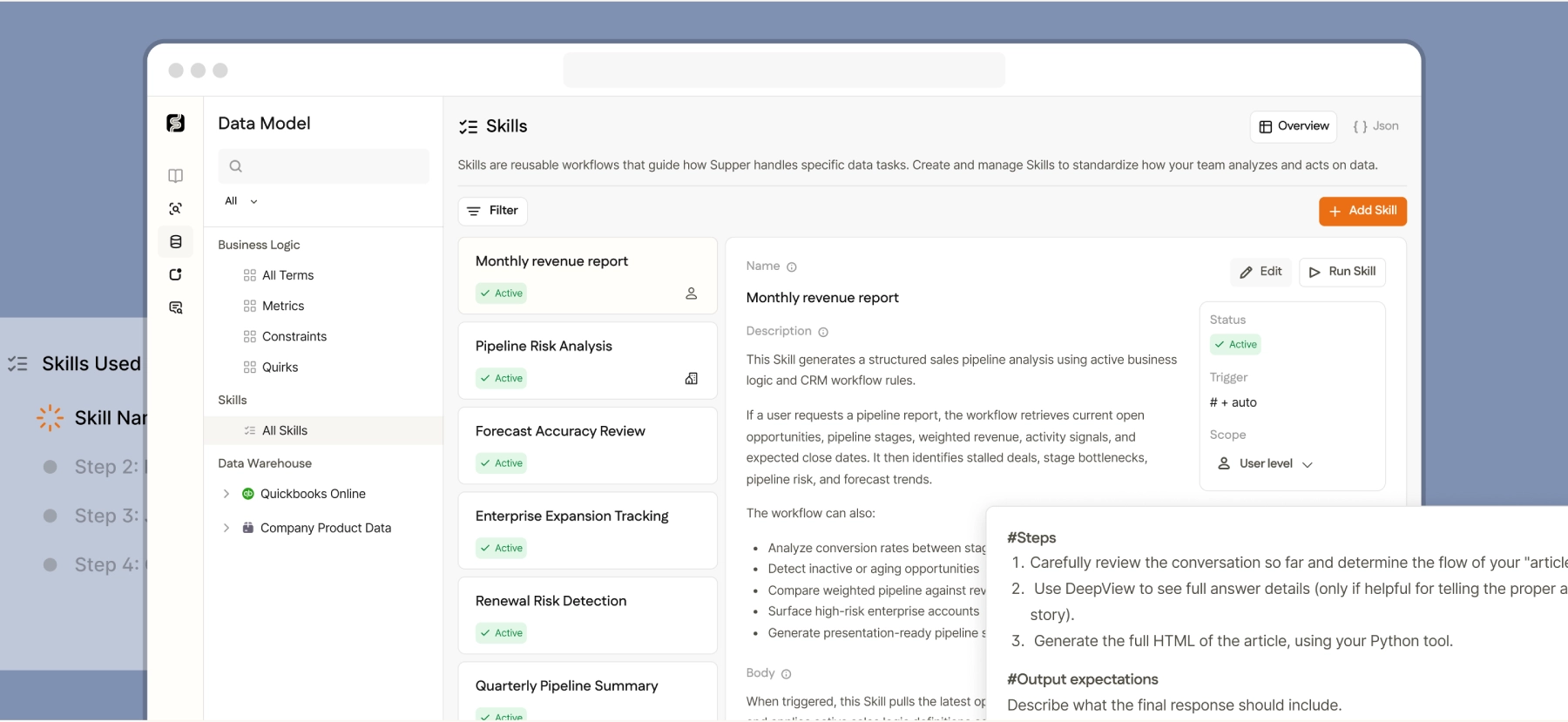
The Data Model Your business logic and reusable skills, encoded once and editable in place — the layer every answer is built on.
A starter content library is generated for you.
While the model is being refined, Supper proactively generates starter content from your connected data — so your team are consumers from day one, not builders. No blank canvas, no "where do I start?"
- Starter conversations — the questions most teams ask first
- Auto-built dashboards — live views of your core metrics
- Data summaries — plain-language overviews per source
- Suggested questions — prompts tailored to your data
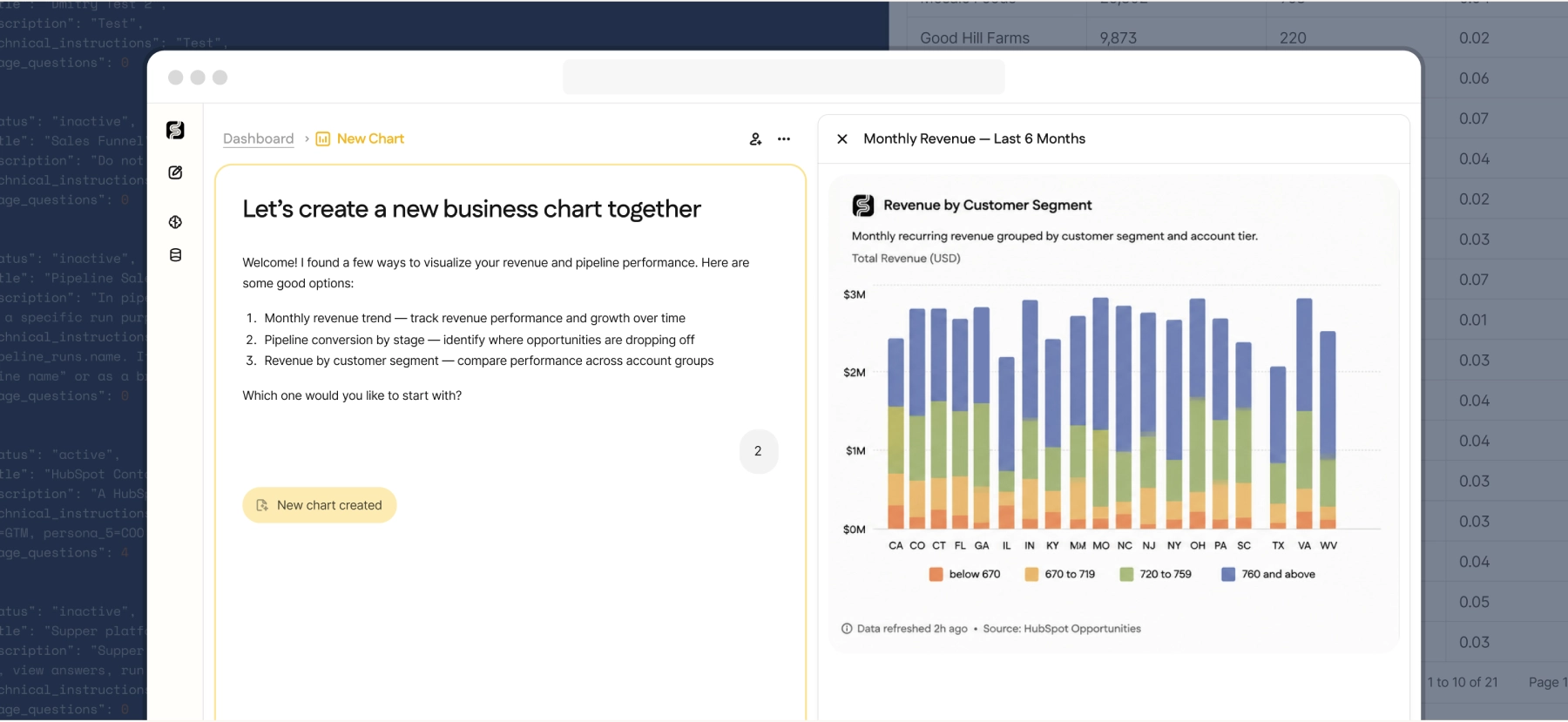
Starter content Supper proposes visualizations and renders charts from live sources — ready to pin to a dashboard or drop into a recurring report.
Your team asks its first real questions.
Your FDA runs a short onboarding with your first group of users. Most get a useful answer within their first ten minutes — in plain language, from live data, with every answer showing the logic it used. Follow-ups work naturally; the agent holds conversation context.
- Plain language — no SQL, no filters, no dashboards to rebuild
- Live data — answered at ask time, not a stale export
- Shows its work — the logic behind every answer, on tap
- Conversational — follow up without re-explaining context
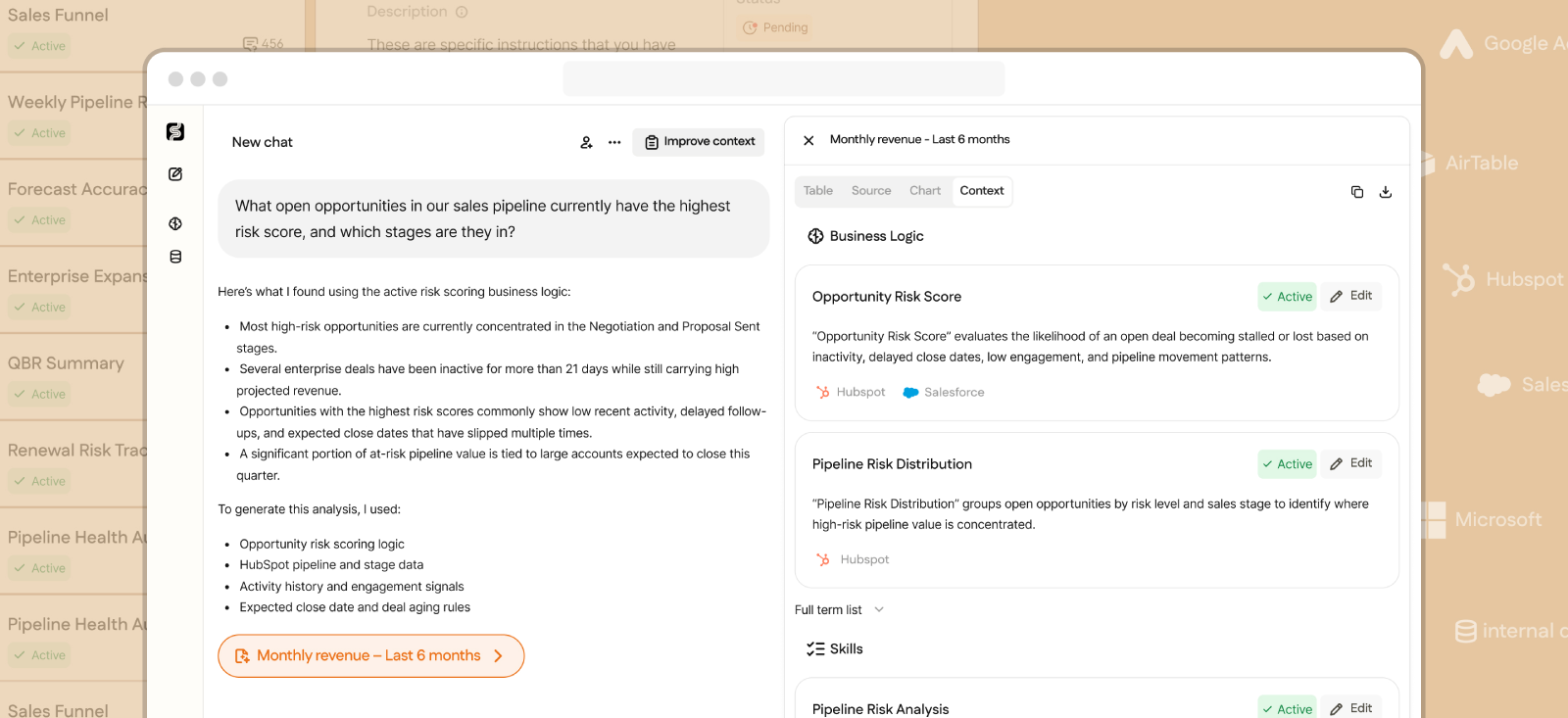
The agent A question, a verified answer, and the Context panel showing exactly which logic and skills produced it — the audit trail built into every response.
Your team grows into the platform.
Your FDA monitors usage, tunes the model against real question patterns, and automates the recurring work — the Monday report that took three hours becomes something that just shows up in Slack. More users come onboard, gaps get shipped same-day, and you end the month with a usage report and a clear picture of what to build next.
- Recurring reports automated on a schedule
- Live dashboards for your most-requested analyses
- Broader rollout — FDA trains your power users
- Usage report — questions answered, time saved, next steps