Run a pilot
Real data. Real questions. Four weeks.
No sandbox. No synthetic datasets. No hand-holding demos.
A Supper pilot runs on your actual data from day one. By the end of 30 days you'll have a working semantic model, live users who've asked real questions, automated skills running, and a clear-eyed view of what full rollout looks like — before you commit to anything.
We handle the setup. You ask the questions. Most pilots can start within a week of the first conversation — and your first users are using Supper by day five.
Two reasons
Setup is 99% automated. And Supper is here to help with the last 1%.
Most pilots stall on the same two things: connectors that need an engineering sprint, and a data team that's already at capacity. We've built around both. The integrations connect themselves; a senior data analyst from our team carries the rest.
Connect your data in minutes, not weeks.
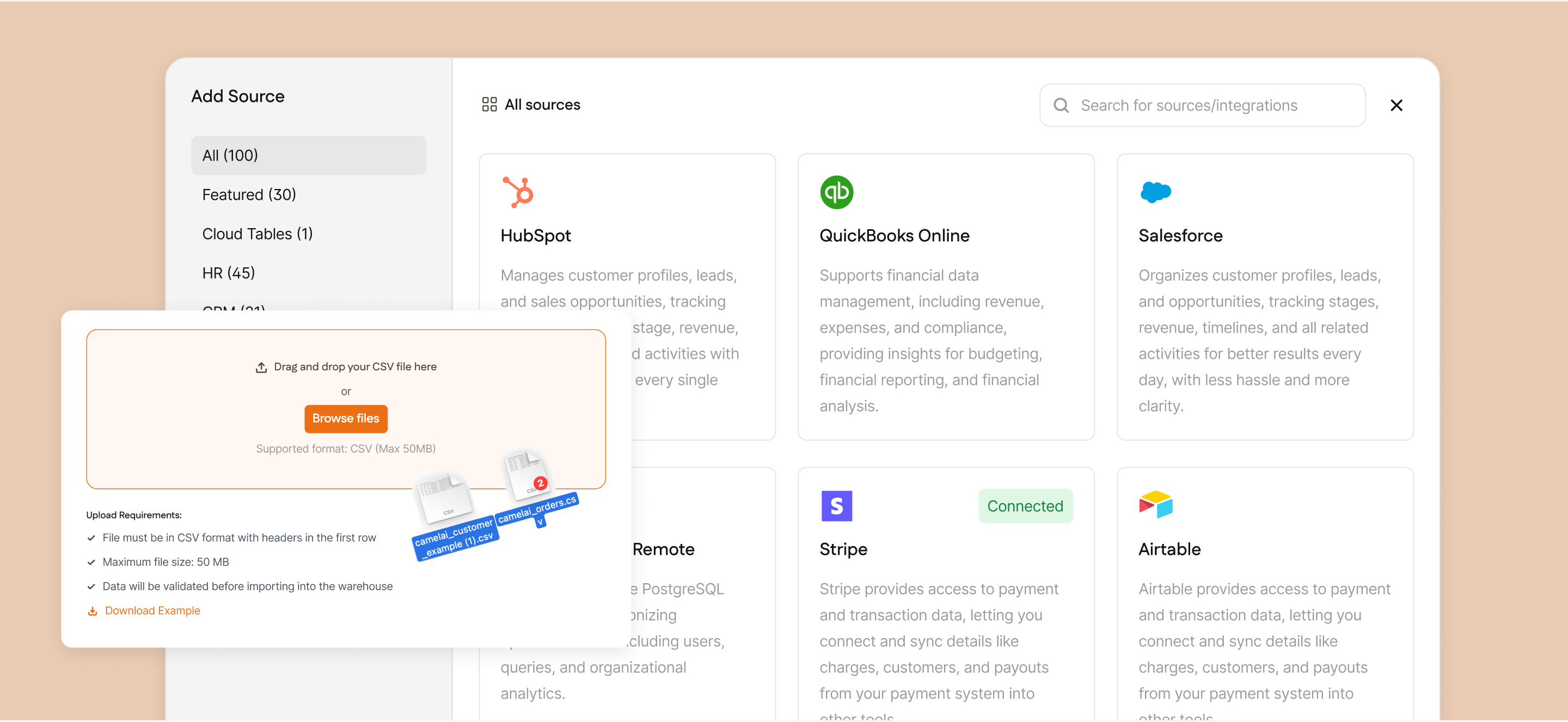
Every integration Supper supports — warehouses, databases, SaaS tools — connects through a guided OAuth flow. No engineering sprint, no connector configuration, no data pipeline to build. You authorize the connection, we handle everything that comes after. CSV upload is there too, for the long tail.
If you're running dbt, Supper reads your semantic models automatically. The work your data team has already done flows straight in.
You have a data expert on your team from day one.
Every pilot includes a dedicated Forward Deployed Analyst — a full-time Supper employee with a senior data background, assigned to your account. They connect your data, build your semantic model, and make sure every answer is accurate before the first user asks a question.
The FDA is not a support ticket. They show up in Slack, they know your data, and they move fast. Most customers cite the FDA relationship as the thing that made the difference between a pilot that worked and one that would have stalled.
Handles the technical setup end to end.
Connectors, schema mapping, the AI-generated semantic model — your FDA runs all of it, with your data team in the loop only where it matters.
Encodes your business logic and metric definitions.
Your ARR formula, your churn definition, your pipeline stages — written down once, applied consistently across every question.
Validates every answer before go-live.
Common questions are tested against ground truth before pilot users see them. Edge cases get caught early, not in front of an executive.
Trains your team so they're confident from day one.
Onboarding sessions, Slack support, and a feedback loop that turns every confusing question into a model improvement, usually same-day.
A 30-day plan
Defined on day one. Reviewed honestly on day thirty.
We define success criteria together at the start — specific, agreed, measurable. At day 30, we review honestly. If it worked, we talk about full rollout. If it didn't, we tell you why and what would need to change.
Connect your sources.
You authorize connections to your data sources through Supper's guided OAuth flow — warehouses, SaaS tools, databases. No engineering required. Your FDA is on the call with you. Most connections complete in minutes. By the end of the day, your data is live in Supper.
AI builds your first semantic model.
While you sleep, Supper's AI scans your connected schemas, maps every table and field, infers relationships across sources, and generates a first-pass semantic model — field names translated to plain language, relationships documented, common metrics pre-configured. You wake up to a working foundation, not a blank page.
Your FDA refines the model with your team.
Your FDA reviews the AI-generated model with your data team — encoding your specific metric definitions, resolving edge cases, and correcting any field inferences that don't match how your business actually works. Your team reviews and approves everything before it goes live. Typical time from your data team: 3–4 hours across three days.
- Your ARR formula, churn definition, pipeline stages encoded to spec
- Conflicting definitions resolved — one canonical version per metric
- Cross-source relationships validated (Salesforce opportunity → Stripe subscription)
- Restricted fields and row-level permissions applied
First users ask their first real questions.
Pilot users get access — typically 5–20 people across two or three teams. Your FDA runs a short onboarding session, helps users ask their first questions, and is on hand to address anything unexpected. Most users get useful answers within the first hour.
Model tuning and first workflows.
As users ask questions, gaps surface. Your FDA monitors every conversation, identifies where the semantic model needs refining, and ships updates — usually same-day. By the end of week two, the model is handling the vast majority of questions correctly. Your FDA also builds the first scheduled workflows: recurring reports that used to be manual, now running automatically.
- Semantic model refined based on real question patterns
- Edge cases caught and resolved before they become habits
- First scheduled workflows set up and validated
- Usage patterns reviewed with your team — what's landing, what needs work
Wider rollout. Dashboards. Deeper integrations.
If the first two weeks went well, the pilot typically expands — more users, more questions, more sources if needed. Your FDA builds out dashboards for your most common analyses and starts training power users who can help onboard the rest of the team after the pilot ends. Any additional sources agreed at kick-off get connected and modeled during this phase.
- Live dashboards built for your highest-frequency analyses
- Power user training — your internal champions ready for full rollout
- Additional data sources connected if scoped at kick-off
- MCP access configured for teams using Claude or other AI tools
Review. Decide. Move forward.
We review the pilot against the success criteria we agreed on day one — usage data, answer quality, time saved, team feedback. If Supper delivered, we talk about full rollout: timeline, pricing, and what the transition looks like. If something needs to change first, we tell you what and why. No pressure in either direction — the review is honest.
We define what a good pilot looks like before it starts.
Most teams find it useful to pin success to two or three specific things — a question type that currently takes days to answer, a report that takes hours to produce manually, a metric that currently has three conflicting definitions. The pilot is structured around proving that Supper solves those things specifically.
- Specific question types answered correctly and consistently
- Time-to-answer compared against the current baseline
- Pilot user adoption and repeat usage
- Data team time spent on ad hoc requests, before and after
Four weeks. Real data. Fast answers.
Most pilots start within a week of the first conversation. Tell us what you're trying to answer and we'll tell you honestly whether Supper is the right fit.