
 THE AI ACCURACY LAYER
Your company doesn’t know what it’s doing.
Fast-growing companies need better information, faster, to make good decisions. As you grow, context gets lost between people and systems. The real knowledge lives in the heads of a few experts, and every department builds its own version of the same metrics. And AI has just compounded the confusion by giving everyone a tool to make their own fragmented view of the world. Nobody has a clear view of what’s actually happening.
Supper gives anyone on your team, or any AI agent, an accurate answer to your hardest data questions from your live data, and it shows its work.
- Why did revenue miss plan this quarter, and which customers, products, regions, or sales behaviors explain most of the variance?
- Which customers look healthy according to our normal dashboards but are actually showing early signs of churn?
- What behaviors in the first 30 days are most predictive of a customer becoming a high-value account 12 months later?
- Find the biggest unexplained changes in the business over the last 30 days and investigate what caused each one.
- Which sales reps are outperforming expectations after controlling for territory, account quality, tenure, and deal mix?
- Which product features appear to increase retention, versus features that are simply used more often by customers who were already likely to retain?
- Build cohorts based on what customers looked like when they signed up, then tell me which characteristics are associated with the best expansion and retention.
- Which customers are costing us substantially more to serve than their revenue would suggest, and what is driving that cost?
- Our conversion rate fell last month. Trace the funnel and tell me where the deterioration occurred, which segments caused it, and what changed in those segments.
- Which closed-lost deals look most similar to deals we normally win, and what appears to have gone wrong?
- If we had increased prices 10% last year, estimate the revenue impact after accounting for discounts, renewals, churn risk, and customer mix.
- Find customers whose product usage, support activity, billing behavior, and CRM activity tell conflicting stories about their health, and explain the discrepancies.
- Which marketing channels actually produce our best customers when we measure them by three-year gross profit rather than leads or first-year revenue?
- What are the major paths customers take through our product, and which sequences of actions are associated with activation, expansion, or churn?
- Find every material discrepancy between what Salesforce says we sold, what our billing system says we invoiced, and what our product data says customers actually received.
- Which metrics changed materially after the product release, and which changes look plausibly related to the release rather than normal variation or seasonality?
- What characteristics distinguish customers who expanded significantly from similar customers who stayed flat?
- If our five largest customers disappeared tomorrow, how would that change revenue growth, gross margin, concentration, retention, and our forecast?
- Look across sales, product, support, billing, and customer-success data and identify the 10 accounts where an executive should intervene this week—and explain why each surfaced.
- Pretend you’re preparing for our board meeting. Analyze the business end-to-end, identify the five developments the board is most likely to care about, investigate each one, and show me the supporting evidence.
The CFO has 48 hours before the QBR, and enterprise NRR just dropped.
“Which enterprise accounts drove the NRR decline from Q2 to Q3? How much was churn, contraction, or fewer expansions? What changed in the 90 days before, and who’s showing the same warning signs today?”
The dashboard shows NRR went down, but not why. An AI tool will tell you why, confidently, using whichever revenue table it found first.
Your warehouse probably holds several plausible revenue tables, and Finance trusts exactly one of them. Billing calls your biggest customer “Acme Corp.” The CRM calls it “Acme Co.” An LLM knows none of this. It has to work it all out from scratch on every question, and it pays for every wrong turn along the way.
Valid SQL. Wrong answer. Nobody notices until the board meeting.
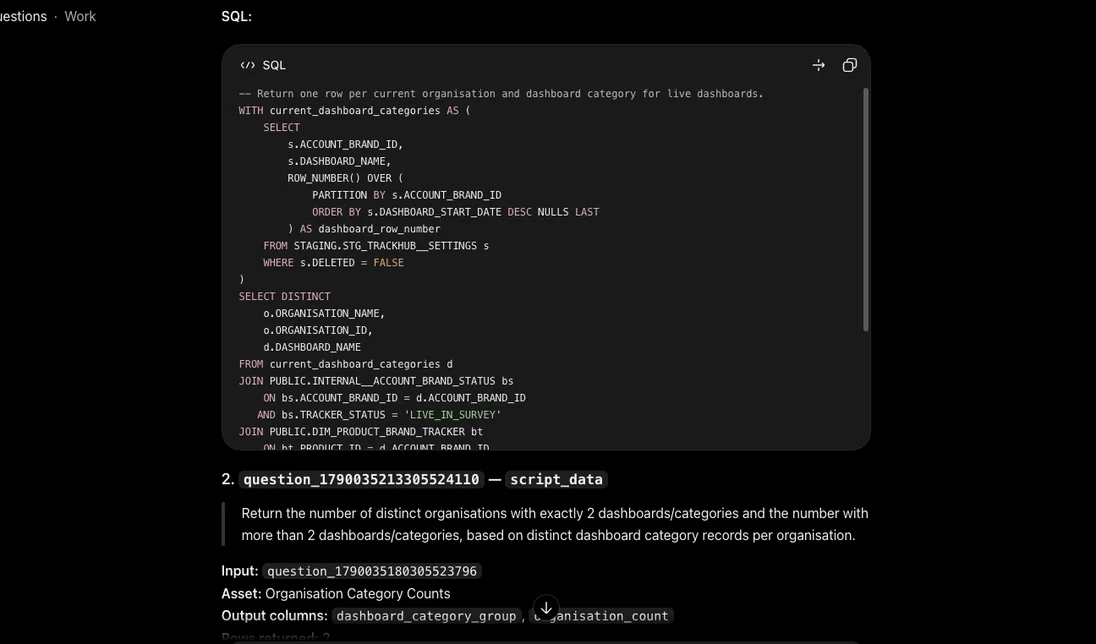
Supper maps your data, definitions, and metrics up front, so every answer is right, every time.
It connects to your warehouse, CRM, billing, and product tools, and we build and maintain every integration ourselves. It maps your business across dozens of dimensions: metrics, customers, edge cases, and the quirks nobody wrote down. Your team reviews and approves the logic. After that, anyone can ask a question in plain language. Answers come back in about 10 seconds on average, with the query behind them. Any answer can also become a recurring report.
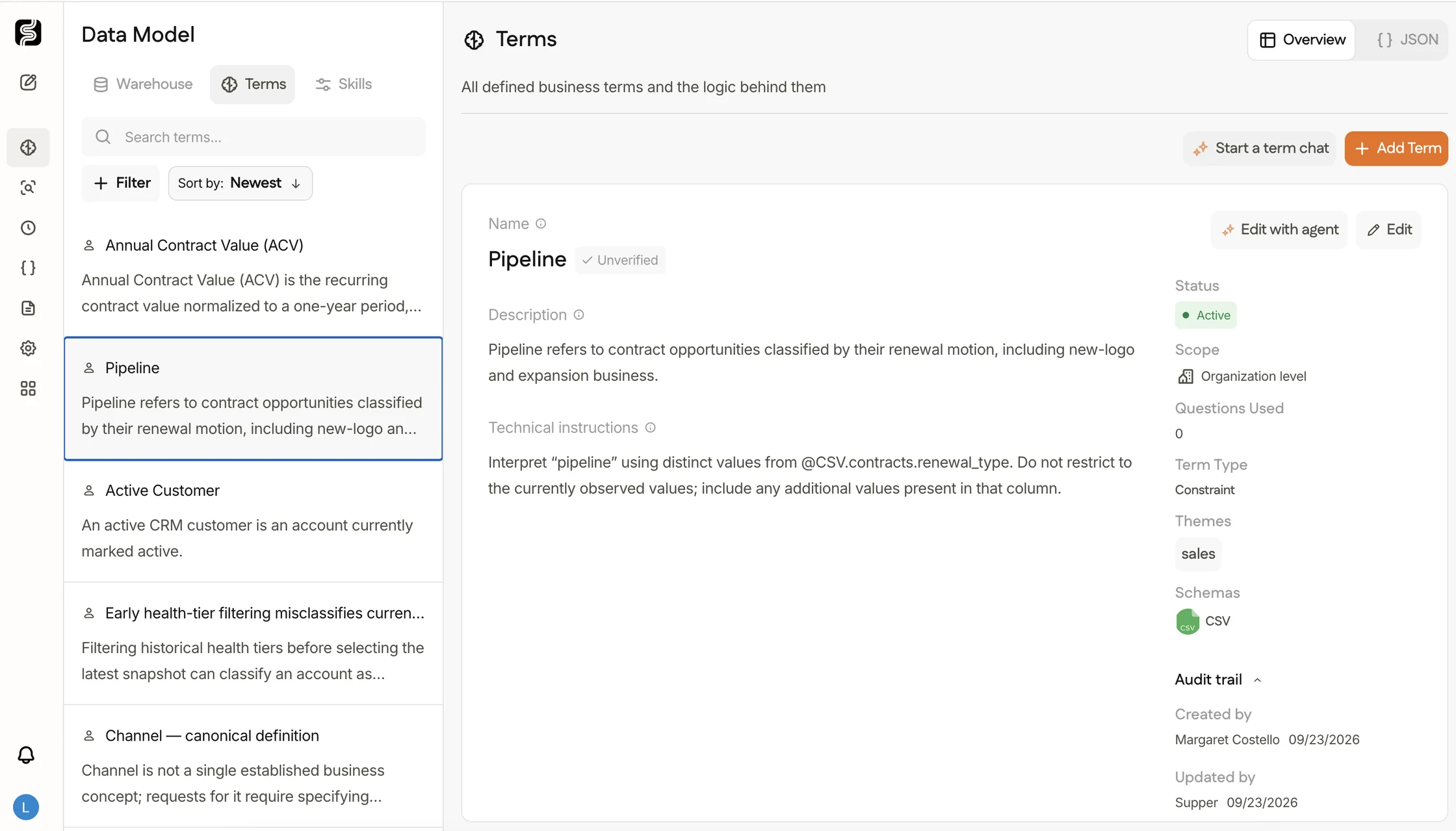
“Are our best reps actually better, or do they just get better leads?”
“Is there a support ticket type that predicts churn 60 days out?”
“Which channel has the best unit economics, not just the cheapest CAC?”
Every answer comes from the same approved model, with the same permissions, wherever you ask the question.
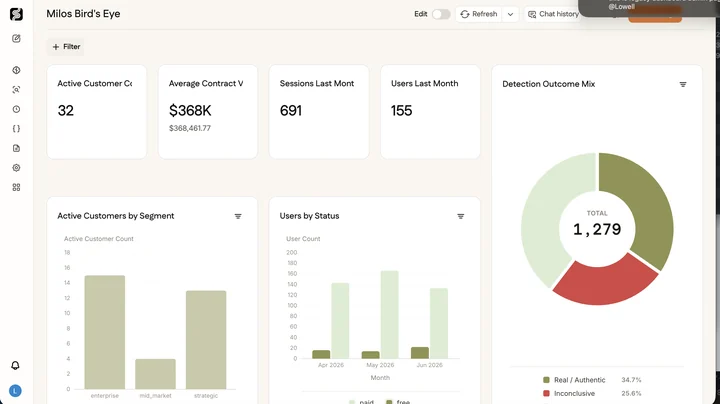
In the Supper app.
Chat, dashboards, and scheduled reports for the whole team, on desktop, mobile, or Slack.
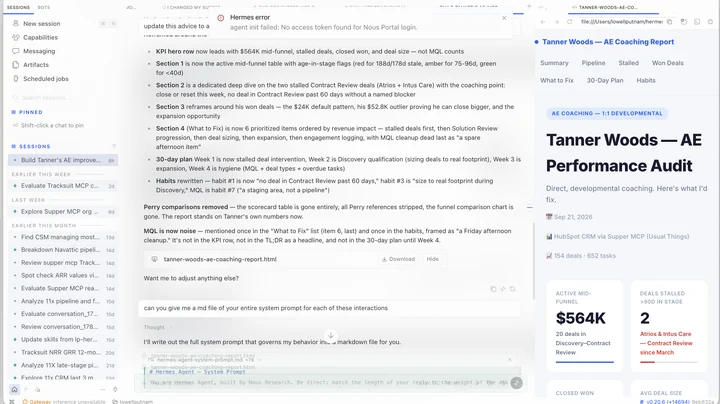
In AI coding tools.
Engineers building in Claude Code, Cursor, or Codex pull trusted data from Supper instead of rebuilding your business logic from scratch.
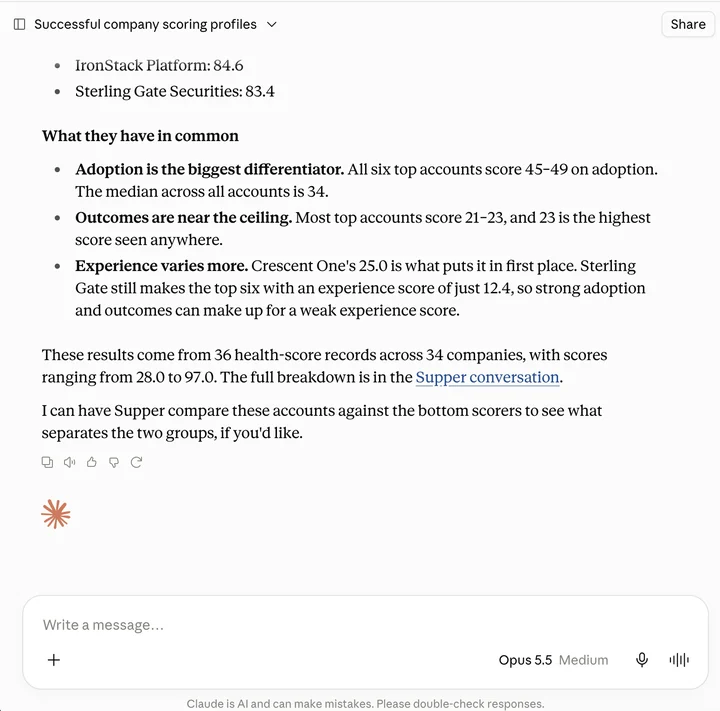
In your agents.
Connect Supper to Claude, ChatGPT, or your own agents, and every answer they give uses your approved definitions.






Flat per-seat pricing. Unlimited usage.
We can price this way because Supper does the expensive thinking before the LLM does, so there’s very little left to pay for. Your costs stay predictable, and nobody ever sees a “you’ve hit your limit” message.
Security.
Read-only access · SOC 2 Type II · permissions enforced at query time · bring your own LLM and storage.
Send us the question your team can’t answer. We’ll connect your data and answer it within five days.
hello@supper.co