Supper
PRODUCT DETAILS
No. 02  ·  May 2026
Product · Accuracy layer

Answers are only useful if you can trust they're right.

Most AI data tools generate code on the fly and hope for the best. Supper runs every question through a semantic model built specifically for your company — your metrics, your definitions, your business logic — before a single number reaches you.

What it is A semantic model + validation layer
Time to answer ~10s, end-to-end
Owned by Your data team
Audit Every query, every time
§ 00

A model of your business,
not a guess at it.

In plain English

Behind every answer Supper returns is a structured map of your company's data and definitions — the things you'd otherwise explain in onboarding docs, Slack threads, or by asking a senior analyst.

If a person can't define "active customer" the same way twice, an AI guessing at SQL is going to get it wrong twice as often. The accuracy layer is what removes the guessing.
§ 01

Six steps before you see an answer.

How a question travels through Supper

Supper doesn't take your question and run a query. It thinks through the question, maps it to your data, applies your business logic, validates the output, and only then returns a result — with a full audit trail.

The same six-step pipeline runs behind every answer Supper returns, whether you asked from chat, a scheduled workflow, a live dashboard, or over MCP. One model. One set of definitions. One audit trail.

  • Supper traverses your entire schema for every question
  • Validation runs before execution — not after a wrong number lands in a deck
  • Business definitions live in a central model, not fragmented across teams
  • Each step is logged with inputs, outputs, and the model version that produced them
  • Override any step manually — your data team can pin a definition or rewrite a query
  • The full trail is exportable to your existing audit and compliance tooling
Question · Lifecycle of a single ask
1
Understand the question parse
The agent parses intent and identifies ambiguities. "Churn this month" means a specific thing at your company.
2
Select the right tables map
Maps the question to relevant sources across warehouses, SaaS tools, and databases — using schema metadata Supper maintains continuously.
3
Apply business logic define
Your ARR formula, qualified-lead criteria, and customer lifecycle stages — encoded, reviewed, and owned by your data team.
4
Write & validate the code CHECK
Supper writes SQL or Python, then checks it against known rules. Queries that don't pass don't reach your data.
5
Run against live data execute
Direct against your live sources. No stale exports, no intermediate copies. The answer reflects what's true right now.
6
Return with audit trail explain
Every answer shows its working — the query, the sources, the logic applied — for anyone to inspect.
§ 02

Exploring and utilizing Supper's semantic model

Business logic · Semantic structure · Intelligence
A.
Business logic layer

Your definition of "revenue." Not a generic one.

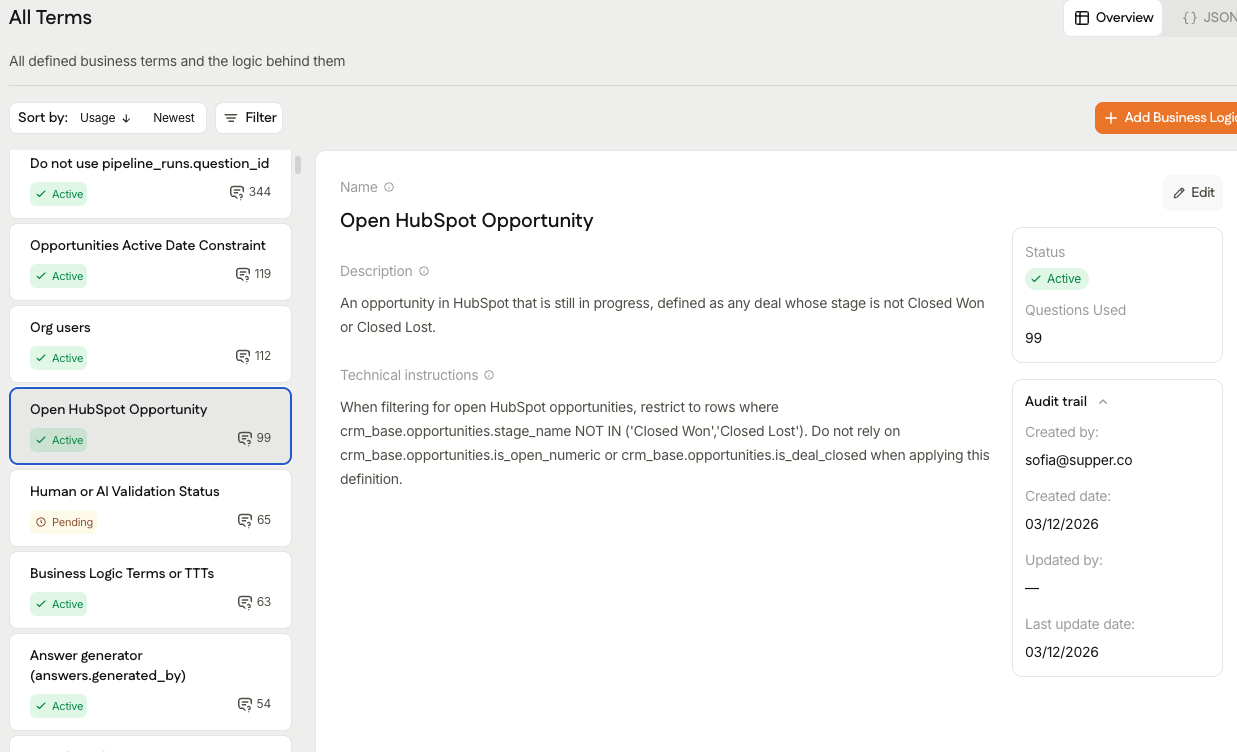
Every company calculates its key metrics differently. MRR, churn, CAC, and pipeline live in spreadsheets, onboarding docs, and people's heads. Supper encodes them into the model before your team asks their first question.

  • Defined once, applied consistently across every question and user
  • Your data team can review and approve every definition before it goes live
  • Editable as the business evolves — versioned, audited, attributed
app.supper.co · business logic · all terms
Business Logic terms list with the 'Open HubSpot Opportunity' definition open, showing description, technical instructions, status, audit trail, and questions used count.
Fig. A · A business term — defined, reviewed, owned.
B.
Semantic structure layer

A map of your entire data world. In plain language.

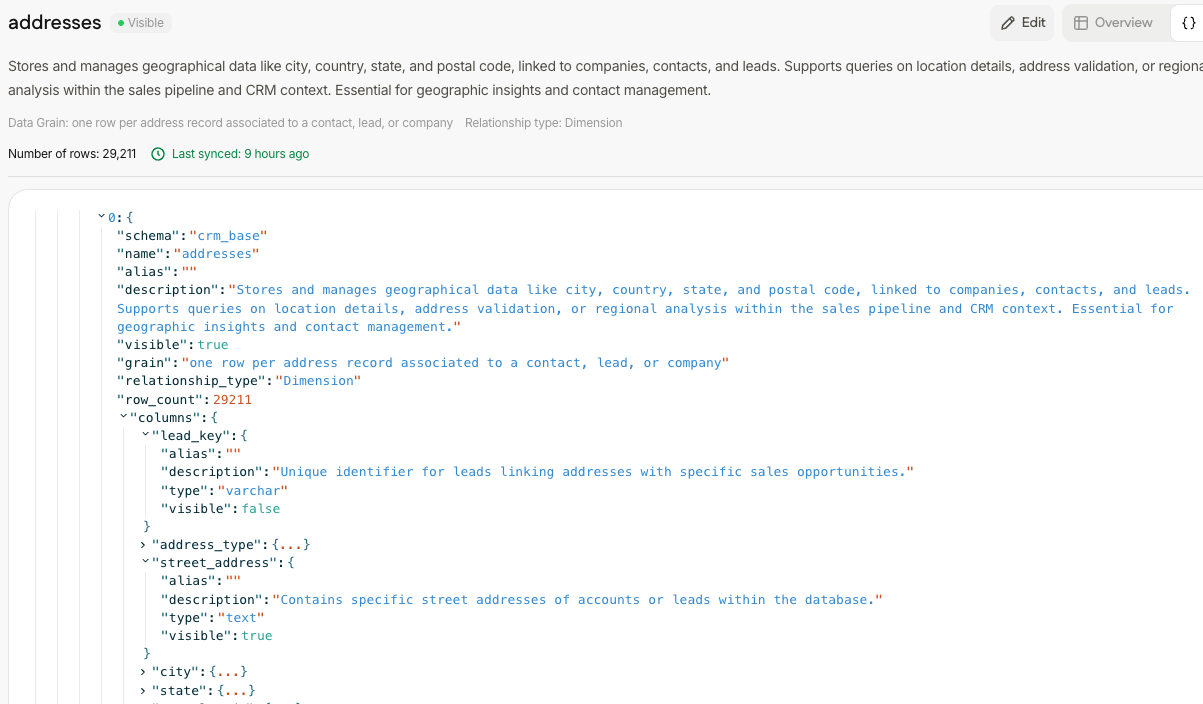
Supper maps every table, field, and relationship in your stack so it's human-readable and AI-navigable. cust_arr_ltm_usd becomes "Customer ARR (last twelve months)." A question spanning Salesforce, Stripe, and your product DB just works.

  • Every connected source covered in one unified model
  • Human-readable names and descriptions for every field
  • Relationships across sources mapped and maintained automatically
app.supper.co · data model · hubspot · addresses
Answer inspector showing a Pipeline Hygiene Audit narrative on the left and the underlying SQL source on the right, demonstrating the audit trail behind a verified answer.
Fig. B · Answer on the left. Working SQL on the right. Always.
C.
Intelligence layer

The query gets written. Then it gets checked.

Supper writes SQL or Python to answer your question, then runs it through a validation engine before execution. Queries that would return wrong answers, expose restricted data, or violate policy never reach your warehouse.

  • AI-generated queries validated before execution, not after
  • Access controls enforced at the query level — not just the UI
  • Audit trail for every query: who asked, what ran, what returned
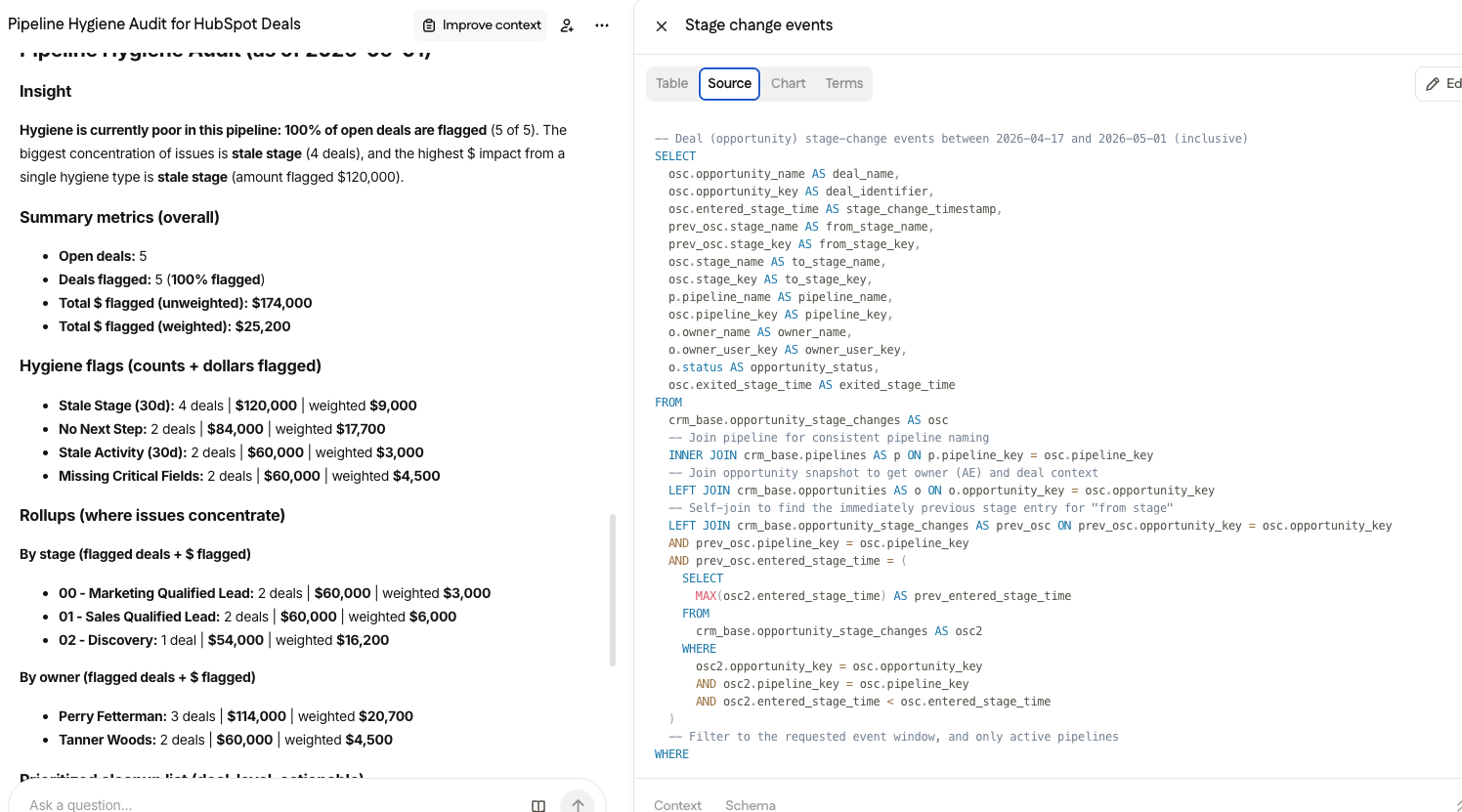
app.supper.co · pipeline hygiene audit · source
Data model browser showing the 'addresses' table with column descriptions, types, and sample values across CRM sources.
Fig. C · Every column described in plain language.
§ 03

The same accuracy behind every Supper surface.

What the accuracy layer powers
Also accessible via
Chat Slack API MCP Webhooks + scheduled workflows
§ 04

Common questions.

FAQs from other Supper customers
Who writes the business logic — Supper, or my team?
Supper's agent writes the semantic model, but your data team owns it. Definitions and descriptions can be updated and tested at any time (manually or with AI assistance).
What if a question is ambiguous or can't be answered?
Supper asks back. If the question maps to a metric we don't have a definition for, the agent flags it and prompts your team to define it before answering.
Where does the data actually live?
In your warehouse, your SaaS tools, your databases. Supper queries them directly under your existing access controls. All answers live in S3 buckets owned by Supper or you.
Can I see the SQL behind any answer?
Yes — every answer ships with the query, the sources, and the business logic applied. Click "Source" on any answer to see exactly what ran.